KEITH SONNIER
LIGHT WORKS, 1968 TO 2017
28 September - 19 December 2018
KEITH SONNIER
LIGHT WORKS, 1968 TO 2017
28 September - 19 December 2018
Text
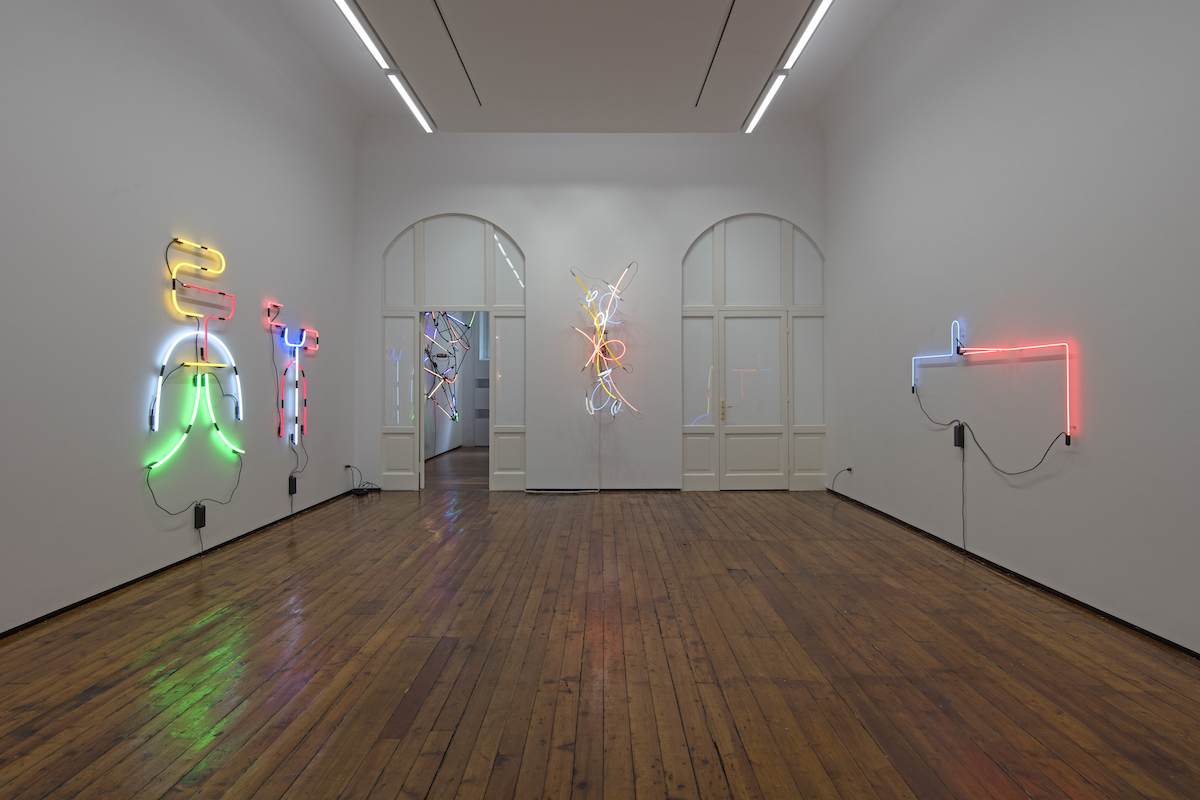
Galleria Fumagalli announces the first solo exhibition of American artist Keith Sonnier, represented exclusively in Italy by the gallery since February 2018. The exhibition documents the evolution of the artist’s creative process from the first historical pieces in 1968 to recent work. Keith Sonnier is among the first and most significant representatives of a generation of artists who pioneered a radical approach to sculpture. Since the late 1960s, he has challenged its preconceived notions by experimenting with industrial and ephemeral materials ranging from latex and satin, to found objects, transmitters and video. In 1968, he began creating wall sculptures using incandescent light bulbs, neon and transformers, experimenting with neon in organic as well as geometric configurations with the aim of giving new form to light and new meaning to the material. Keith Sonnier often works in series, some of which have spanned the course of his career. Elements of such early experimental sculptural works are often recognizable in subsequent installations, even in the architectural interventions on a more monumental scale. The exhibition “Keith Sonnier. Light Works, 1968 to 2017” offers a curated selection of Sonnier’s iconic sculptures from various periods of his career ranging from the first series from the late Sixties such as the “Lit Circle” series (1968), “Neon Wrapping Incandescent” series (1970) and “Sel” series (1978-2003), to the most recent ones, including the “Chandelier” series (2006-), “Portal” series (2015) and “Floating Grid” series (2017). Keith Sonnier uses neon to create spatial dimensions by interweaving lines, arcs, curves of light and color that interact with the surrounding architecture.
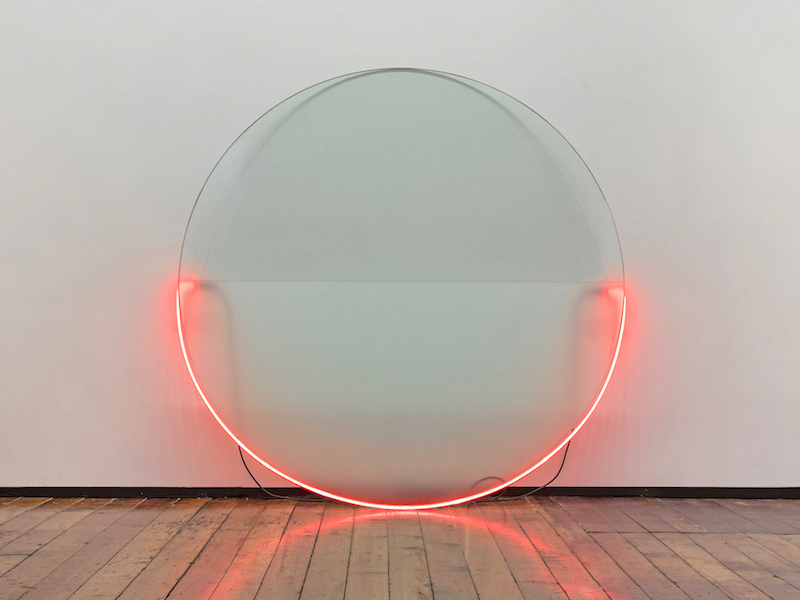
The perceptual effects of Keith Sonnier’s early work such as “Lit Circle Red with Etched Glass” (1968) show the artist’s ability to manipulate difficult materials with seemingly offhanded ease: this work’s regular curves, iconic shape and the light form replicating its primary shape suggest the duality of impermanence and presence by reacting and responding to the reflective and transparent surface of plate glass. From the same period, “Neon Wrapping Incandescent I” (1970) goes further overtaking geometry and clear logical orderings opting for a loose lyricism. The title describes the essential formal strategy of the series: colored tubing curls around a wall-mounted porcelain fixture containing an incandescent bulb. “Comus” and “Proteus” (1978-2003) from the “Sel” series are instead composed of lines of neon that form a three-dimensional line evocative of calligraphy and producing a multi-colored glow. The Sel calligraphy is one of the oldest forms of Chinese script that Sonnier combines with the initials of friends. In the more recent works, such as the “Portal” series neon is investigated architecturally as well as iconographically, serving as an entrance point for readers to examine Sonnier’s process. In this case, the artist has taken the orphic allegory of the portal and explored its various historical manifestations, evoking something more corporeal than architectural. The interconnection of line and color follows a research both on the design and structure on paper and in the neon tubes that bend and intertwine in real space. The drawing in show “Cat Doucet XI” (1995) was inspired by the moniker of a legendary sheriff of Saint Landry Parish who was Sonnier’s father’s contemporary. For his re-election campaign of 1952 Doucet traveled the parish in a station wagon with four large speakers mounted on its roof along with a cut-out figure of a cat, dark against outlining, sporting a cartoonish grin and long curving tail.
Keith Sonnier (Mamou, Louisiana 1941 – Southampton, New York 2020) radically reinvented sculpture in the late 1960s. After graduating with a B.A. from the University of Southwestern Louisiana, Lafayette in 1963, he went on to receive an M.F.A. from Rutgers University in 1966. Employing previously considered unusual materials, Sonnier, along with his contemporaries, Eva Hesse, Barry Le Va, Bruce Nauman, Richard Serra, Joel Shapiro, Richard Tuttle, and Jackie Winsor, called all previous concepts of sculpture into question. He experimented with a wide range of materials and in 1968 began working with neon which quickly became a defining element of his work. Sonnier has been the subject of more than 130 solo exhibitions and has participated in more than 360 group exhibitions throughout his career, including: “When Attitudes Become Form” (1969), Kunsthalle Bern; “Anti-Illusion: Procedures/Materials” (1969), The Whitney Museum of American Art, New York; “Information” (1970), MoMA, New York; Documenta 5, Kassel (1972); “Keith Sonnier: Neon” (1989) at the Hirshhorn Museum and Sculpture Garden, Washington, D.C.; “Keith Sonnier: Porte Vue” (1979) at the Musée National d’Art Moderne, Centre Georges Pompidou, Paris; “Projects: Keith Sonnier” (1971) at the Museum of Modern Art, New York; the Venice Biennale (1972, 1982); the “Whitney Museum of American Art’s 1970 Annual Exhibition: Contemporary American Sculpture”, Biennial Exhibitions (1973, 1977) and “The New Sculpture 1965 – 1975: Between Geometry and Gesture” (1990) which then moved to the Museum of Contemporary Art in Los Angeles. His work has been recently featured in two solo museum exhibitions in the United States, namely the DIA/Dan Flavin Institute and the Parrish Art Museum in Bridgehampton and Water Mill New York respectively.
Text
Galleria Fumagalli announces the first solo exhibition of American artist Keith Sonnier, represented exclusively in Italy by the gallery since February 2018. The exhibition documents the evolution of the artist’s creative process from the first historical pieces in 1968 to recent work. Keith Sonnier is among the first and most significant representatives of a generation of artists who pioneered a radical approach to sculpture. Since the late 1960s, he has challenged its preconceived notions by experimenting with industrial and ephemeral materials ranging from latex and satin, to found objects, transmitters and video. In 1968, he began creating wall sculptures using incandescent light bulbs, neon and transformers, experimenting with neon in organic as well as geometric configurations with the aim of giving new form to light and new meaning to the material. Keith Sonnier often works in series, some of which have spanned the course of his career. Elements of such early experimental sculptural works are often recognizable in subsequent installations, even in the architectural interventions on a more monumental scale. The exhibition “Keith Sonnier. Light Works, 1968 to 2017” offers a curated selection of Sonnier’s iconic sculptures from various periods of his career ranging from the first series from the late Sixties such as the “Lit Circle” series (1968), “Neon Wrapping Incandescent” series (1970) and “Sel” series (1978-2003), to the most recent ones, including the “Chandelier” series (2006-), “Portal” series (2015) and “Floating Grid” series (2017). Keith Sonnier uses neon to create spatial dimensions by interweaving lines, arcs, curves of light and color that interact with the surrounding architecture.
The perceptual effects of Keith Sonnier’s early work such as “Lit Circle Red with Etched Glass” (1968) show the artist’s ability to manipulate difficult materials with seemingly offhanded ease: this work’s regular curves, iconic shape and the light form replicating its primary shape suggest the duality of impermanence and presence by reacting and responding to the reflective and transparent surface of plate glass. From the same period, “Neon Wrapping Incandescent I” (1970) goes further overtaking geometry and clear logical orderings opting for a loose lyricism. The title describes the essential formal strategy of the series: colored tubing curls around a wall-mounted porcelain fixture containing an incandescent bulb. “Comus” and “Proteus” (1978-2003) from the “Sel” series are instead composed of lines of neon that form a three-dimensional line evocative of calligraphy and producing a multi-colored glow. The Sel calligraphy is one of the oldest forms of Chinese script that Sonnier combines with the initials of friends. In the more recent works, such as the “Portal” series neon is investigated architecturally as well as iconographically, serving as an entrance point for readers to examine Sonnier’s process. In this case, the artist has taken the orphic allegory of the portal and explored its various historical manifestations, evoking something more corporeal than architectural. The interconnection of line and color follows a research both on the design and structure on paper and in the neon tubes that bend and intertwine in real space. The drawing in show “Cat Doucet XI” (1995) was inspired by the moniker of a legendary sheriff of Saint Landry Parish who was Sonnier’s father’s contemporary. For his re-election campaign of 1952 Doucet traveled the parish in a station wagon with four large speakers mounted on its roof along with a cut-out figure of a cat, dark against outlining, sporting a cartoonish grin and long curving tail.
Keith Sonnier (Mamou, Louisiana 1941 – Southampton, New York 2020) radically reinvented sculpture in the late 1960s. After graduating with a B.A. from the University of Southwestern Louisiana, Lafayette in 1963, he went on to receive an M.F.A. from Rutgers University in 1966. Employing previously considered unusual materials, Sonnier, along with his contemporaries, Eva Hesse, Barry Le Va, Bruce Nauman, Richard Serra, Joel Shapiro, Richard Tuttle, and Jackie Winsor, called all previous concepts of sculpture into question. He experimented with a wide range of materials and in 1968 began working with neon which quickly became a defining element of his work. Sonnier has been the subject of more than 130 solo exhibitions and has participated in more than 360 group exhibitions throughout his career, including: “When Attitudes Become Form” (1969), Kunsthalle Bern; “Anti-Illusion: Procedures/Materials” (1969), The Whitney Museum of American Art, New York; “Information” (1970), MoMA, New York; Documenta 5, Kassel (1972); “Keith Sonnier: Neon” (1989) at the Hirshhorn Museum and Sculpture Garden, Washington, D.C.; “Keith Sonnier: Porte Vue” (1979) at the Musée National d’Art Moderne, Centre Georges Pompidou, Paris; “Projects: Keith Sonnier” (1971) at the Museum of Modern Art, New York; the Venice Biennale (1972, 1982); the “Whitney Museum of American Art’s 1970 Annual Exhibition: Contemporary American Sculpture”, Biennial Exhibitions (1973, 1977) and “The New Sculpture 1965 – 1975: Between Geometry and Gesture” (1990) which then moved to the Museum of Contemporary Art in Los Angeles. His work has been recently featured in two solo museum exhibitions in the United States, namely the DIA/Dan Flavin Institute and the Parrish Art Museum in Bridgehampton and Water Mill New York respectively.
Installation views


Installation views
Press
exibart.com
26 November 2018
“Keith Sonnier, Light Works, 1968 to 2017. Galleria Fumagalli Milano”
artribune.com
25 October 2018
“Neon e disegni dagli anni Sessanta a oggi. Keith Sonnier a Milano”
Press
exibart.com
26 November 2018
“Keith Sonnier, Light Works, 1968 to 2017. Galleria Fumagalli Milano”
artribune.com
25 October 2018
“Neon e disegni dagli anni Sessanta a oggi. Keith Sonnier a Milano”