GIULIO PAOLINI
TEORIA DELLE APPARENZE
16 January to 14 April 2018
GIULIO PAOLINI
TEORIA DELLE APPARENZE
16 January to 14 April 2018
Text
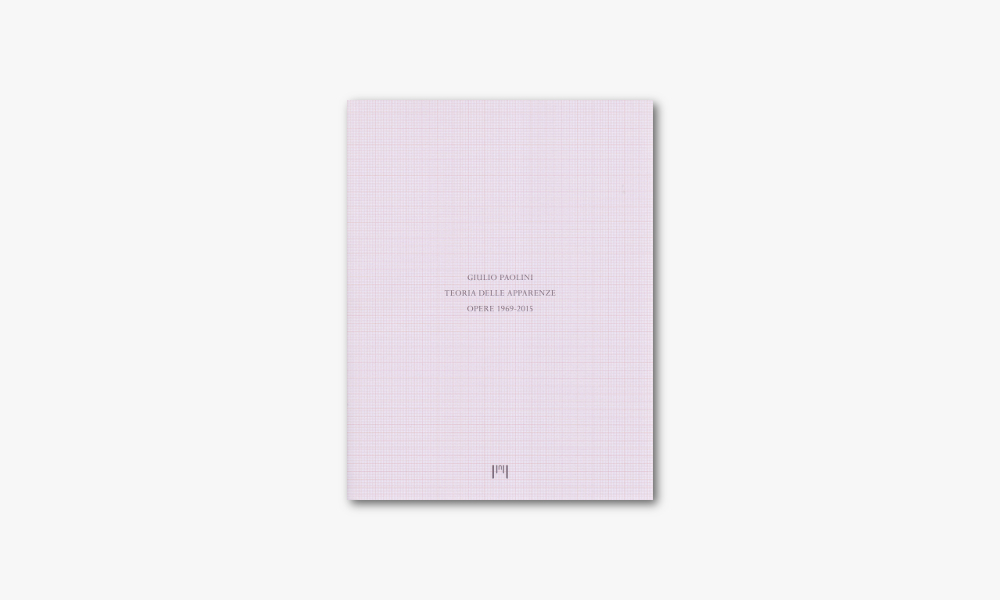
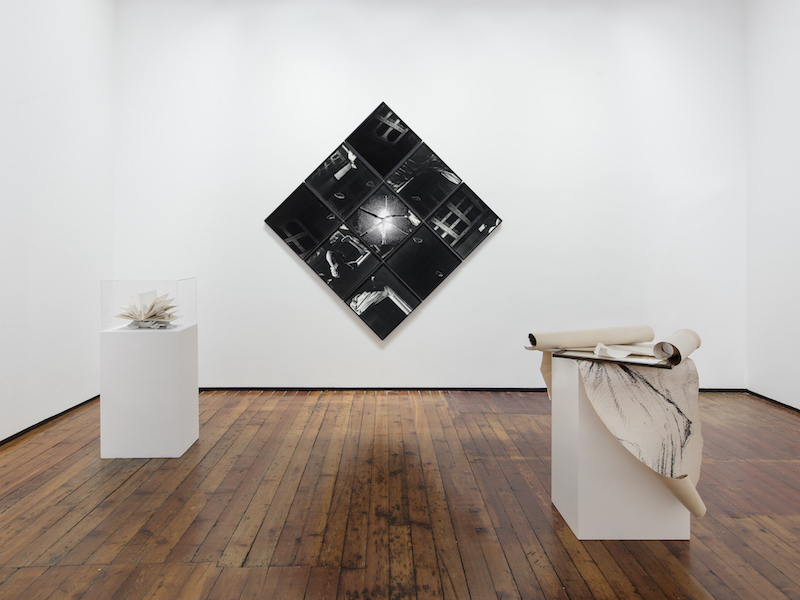
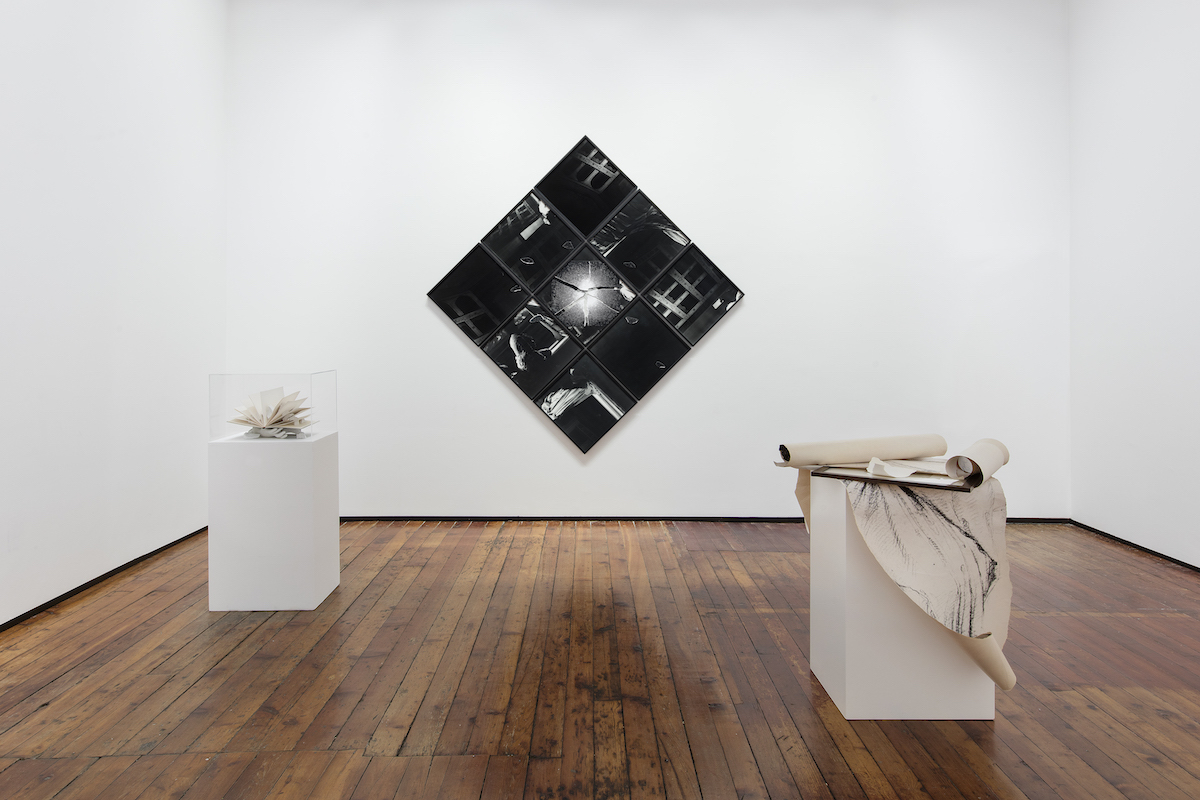
Galleria Fumagalli presents the exhibition “Giulio Paolini. Teoria delle apparenze”, a selection of works from 1969 to 2015. Embracing the whole production of the artist, issued from a conceptual area of research, the exhibition gives an overview of Giulio Paolini’s work: from the perspective paintings of the ‘70s, to the theatrical and literary dimension of the ‘80s, until the recent studies on the author identity and his condition as a spectator.
The founding moment of Giulio Paolini’s artistic research dates back to “Disegno geometrico” from 1960, a small canvas (40×60 cm) on which the artist traced the squaring of the surface. From this moment on, Giulio Paolini identifies as his field of interest the fundaments of vision and the methods of the artistic work. Thereafter, he develops a decoding process free from image processing and close to sign, geometric vision and mathematics. The selected works displayed in the exhibition “Giulio Paolini. Teoria delle apparenze” follow the artist’s path starting from 1969 with the work “Quam raptim ad sublimia”, a cotton standard with the Latin inscription “to the sublime as soon as possible”. The phrase, taken by the artist from a brass engraving in the marble floor of the Vatican Museum, evokes the ineffable nature of words. As for language as for painting, the artist explores with a retrospective attitude the mechanisms and the constitutive elements of showing: from literary quotations to self-reference, he proposes a historicization of his own work. Deceptive perspectival lines and images, in works such as “Teoria delle apparenze” (1972) and “Equivalenza” (1975), are virtual propositions of space and allude to the idea of the painting as a potential repository for all past and future works. Since the mid-70s, themes such as repetition and circularity of references are present in the work of Giulio Paolini. Thanks also to the use of plaster casts of statues or classical architectural details, the artist reflects on tradition as only perceivable in fragments.
Representative in this sense are “L’arte e lo spazio, quattro illustrazioni per uno scritto di Martin Heidegger” (1983), a reference to the “four observations” of the German philosopher paradigm of the aesthetic discourse in those years, and “Grandezza Naturale” (1986/87), which questions the meaning and the paradox of the notion of “natural”. The photographic collage “Comédie Italienne” (1984) is a documentation of the scenic fragment created by the artist with Carlo Quartucci in 1983 at the Ninfeo del Bramante, inspired by the famous painting by Jean-Antoine Watteau ”Embarquement pour Cyhtère”. The work evokes the myth of the eternal journey of Italian comedians and refers to another characteristic aspect of Giulio Paolini’s oeuvre: the theatricalization of the work. Also “L’Indifferent” (1992) is a reference to the Watteau painting of 1717, reproduced in a color photograph (missing some parts cut out by the artist) and framed on a wooden easel. The visual perception is challenged and actively involves the viewer in the definition of the work. Emblematic is “Terra di nessuno” (2013/2014), an easel with a canvas and four fragments of a perspective drawing in a showcase evoking a painting yet not reveling it. Also on show “Studio per Da lontano” (2015), a preparatory drawing of Giulio Paolini’s intervention for the Baroque temple of Museo Cappella Sansevero in Naples, and “Studio per Villa dei misteri” (2013), a composition of images in perspective whose title is inspired by the Pompeian domus. With the exhibition “Giulio Paolini. Teoria delle apparenze”, Galleria Fumagalli pays homage to one of the most representative artists of the Italian avant-garde. Through installation, drawing, collage, plaster cast and photography, from the ’60s till today, Giulio Paolini explores the tautological and metaphysical nature of the artistic practice questioning its method structures and regenerating the work in always new perspectives. “My way of operating is in relationship, a continuous relay, between the previous and upcoming artwork. Every painting is ultimately the replica of the previous one (I would say that it comes to life as a replica of the previous one)”. (Giulio Paolini in “Dipingere la pittura”, interview by Nico Orengo in “Fuoricampo”, Turin 1973).
Giulio Paolini was born in Genoa in 1940, he lives and works in Turin. From the beginning in the early 60s his analytical research affirms the work of art as a pure attestation of itself and as a specific linguistic tool of the artistic field. Starting from the exposition of the material codes of the painting system (such as the white canvas, the sheet, the frame, etc.) Giulio Paolini’s interest is turned to representation as a category of expressivity, moving an investigation on art starting from its history and as a sedimentation of a knowledge to be questioned always. Over the years his work has been shown in eminent international public institutions, among the latest solo shows: Center for Italian Modern Art, New York and Museo Poldi Pezzoli, Milan (2016), Macro, Rome (2013), Palazzo delle Esposizioni, Rome (2010), Kunstmuseum, Winterthur and Westfälisches Landesmuseum, Münster (2005), Mart, Rovereto (2004), Fondazione Prada, Milan (2003), CEAAC, Strasbourg and GAM, Turin (2001), Museo d’Arte Contemporanea Castello di Rivoli, Turin (1999, 1991, 1986), Mamco, Geneve (1999), Neue Galerie, Graz (1998), Palazzo della Ragione, Padua (1995), Kunstmuseum, Winterthur (1993), Kölnischer Kunstverein, Koln and Museo di Capodimonte, Naples (1988), Musée d’art contemporain, Montréal (1985), PAC, Milan and Neuer Berliner Kunstverein, Berlin (1982), Galleria Nazionale d’Arte Moderna, Rome (1981), Stedelijk Museum, Amsterdam and Museum of Modern Art, Oxford (1980), Musée d’Art Moderne de la Ville de Paris (1978), Museum of Modern Art, New York (1974). His works are permanently displayed in public and private institutions all over the world such as Museo d’Arte Contemporanea Castello di Rivoli, Turin; Centro per l’arte contemporanea Luigi Pecci, Prato; FRAC Bourgogne, Dijon; Galleria nazionale d’arte moderna and contemporanea, Rome; Mart, Rovereto; MAXXI, Rome; Musée d’art contemporain, Montréal; Musée d’Art Moderne, Brussels; Musée des Beaux-Arts, Nantes; Museo del Novecento, Milan; Museum Boijmans Van Beuningen, Rotterdam; Museum Moderner Kunst Stiftung Ludwig, Vienna; National Gallery of Art, Washington D.C.; Nationalgalerie, Berlin; Museum of Modern Art, San Francisco; Solomon R. Guggenheim Museum, New York; Stedelijk Museum, Amsterdam; Tate, London; The Art Institute, Chicago; Walker Art Center, Minneapolis.
Text
Galleria Fumagalli presents the exhibition “Giulio Paolini. Teoria delle apparenze”, a selection of works from 1969 to 2015. Embracing the whole production of the artist, issued from a conceptual area of research, the exhibition gives an overview of Giulio Paolini’s work: from the perspective paintings of the ‘70s, to the theatrical and literary dimension of the ‘80s, until the recent studies on the author identity and his condition as a spectator.
The founding moment of Giulio Paolini’s artistic research dates back to “Disegno geometrico” from 1960, a small canvas (40×60 cm) on which the artist traced the squaring of the surface. From this moment on, Giulio Paolini identifies as his field of interest the fundaments of vision and the methods of the artistic work. Thereafter, he develops a decoding process free from image processing and close to sign, geometric vision and mathematics. The selected works displayed in the exhibition “Giulio Paolini. Teoria delle apparenze” follow the artist’s path starting from 1969 with the work “Quam raptim ad sublimia”, a cotton standard with the Latin inscription “to the sublime as soon as possible”. The phrase, taken by the artist from a brass engraving in the marble floor of the Vatican Museum, evokes the ineffable nature of words. As for language as for painting, the artist explores with a retrospective attitude the mechanisms and the constitutive elements of showing: from literary quotations to self-reference, he proposes a historicization of his own work. Deceptive perspectival lines and images, in works such as “Teoria delle apparenze” (1972) and “Equivalenza” (1975), are virtual propositions of space and allude to the idea of the painting as a potential repository for all past and future works. Since the mid-70s, themes such as repetition and circularity of references are present in the work of Giulio Paolini. Thanks also to the use of plaster casts of statues or classical architectural details, the artist reflects on tradition as only perceivable in fragments.
Representative in this sense are “L’arte e lo spazio, quattro illustrazioni per uno scritto di Martin Heidegger” (1983), a reference to the “four observations” of the German philosopher paradigm of the aesthetic discourse in those years, and “Grandezza Naturale” (1986/87), which questions the meaning and the paradox of the notion of “natural”. The photographic collage “Comédie Italienne” (1984) is a documentation of the scenic fragment created by the artist with Carlo Quartucci in 1983 at the Ninfeo del Bramante, inspired by the famous painting by Jean-Antoine Watteau ”Embarquement pour Cyhtère”. The work evokes the myth of the eternal journey of Italian comedians and refers to another characteristic aspect of Giulio Paolini’s oeuvre: the theatricalization of the work. Also “L’Indifferent” (1992) is a reference to the Watteau painting of 1717, reproduced in a color photograph (missing some parts cut out by the artist) and framed on a wooden easel. The visual perception is challenged and actively involves the viewer in the definition of the work. Emblematic is “Terra di nessuno” (2013/2014), an easel with a canvas and four fragments of a perspective drawing in a showcase evoking a painting yet not reveling it. Also on show “Studio per Da lontano” (2015), a preparatory drawing of Giulio Paolini’s intervention for the Baroque temple of Museo Cappella Sansevero in Naples, and “Studio per Villa dei misteri” (2013), a composition of images in perspective whose title is inspired by the Pompeian domus. With the exhibition “Giulio Paolini. Teoria delle apparenze”, Galleria Fumagalli pays homage to one of the most representative artists of the Italian avant-garde. Through installation, drawing, collage, plaster cast and photography, from the ’60s till today, Giulio Paolini explores the tautological and metaphysical nature of the artistic practice questioning its method structures and regenerating the work in always new perspectives. “My way of operating is in relationship, a continuous relay, between the previous and upcoming artwork. Every painting is ultimately the replica of the previous one (I would say that it comes to life as a replica of the previous one)”. (Giulio Paolini in “Dipingere la pittura”, interview by Nico Orengo in “Fuoricampo”, Turin 1973).
Giulio Paolini was born in Genoa in 1940, he lives and works in Turin. From the beginning in the early 60s his analytical research affirms the work of art as a pure attestation of itself and as a specific linguistic tool of the artistic field. Starting from the exposition of the material codes of the painting system (such as the white canvas, the sheet, the frame, etc.) Giulio Paolini’s interest is turned to representation as a category of expressivity, moving an investigation on art starting from its history and as a sedimentation of a knowledge to be questioned always. Over the years his work has been shown in eminent international public institutions, among the latest solo shows: Center for Italian Modern Art, New York and Museo Poldi Pezzoli, Milan (2016), Macro, Rome (2013), Palazzo delle Esposizioni, Rome (2010), Kunstmuseum, Winterthur and Westfälisches Landesmuseum, Münster (2005), Mart, Rovereto (2004), Fondazione Prada, Milan (2003), CEAAC, Strasbourg and GAM, Turin (2001), Museo d’Arte Contemporanea Castello di Rivoli, Turin (1999, 1991, 1986), Mamco, Geneve (1999), Neue Galerie, Graz (1998), Palazzo della Ragione, Padua (1995), Kunstmuseum, Winterthur (1993), Kölnischer Kunstverein, Koln and Museo di Capodimonte, Naples (1988), Musée d’art contemporain, Montréal (1985), PAC, Milan and Neuer Berliner Kunstverein, Berlin (1982), Galleria Nazionale d’Arte Moderna, Rome (1981), Stedelijk Museum, Amsterdam and Museum of Modern Art, Oxford (1980), Musée d’Art Moderne de la Ville de Paris (1978), Museum of Modern Art, New York (1974). His works are permanently displayed in public and private institutions all over the world such as Museo d’Arte Contemporanea Castello di Rivoli, Turin; Centro per l’arte contemporanea Luigi Pecci, Prato; FRAC Bourgogne, Dijon; Galleria nazionale d’arte moderna and contemporanea, Rome; Mart, Rovereto; MAXXI, Rome; Musée d’art contemporain, Montréal; Musée d’Art Moderne, Brussels; Musée des Beaux-Arts, Nantes; Museo del Novecento, Milan; Museum Boijmans Van Beuningen, Rotterdam; Museum Moderner Kunst Stiftung Ludwig, Vienna; National Gallery of Art, Washington D.C.; Nationalgalerie, Berlin; Museum of Modern Art, San Francisco; Solomon R. Guggenheim Museum, New York; Stedelijk Museum, Amsterdam; Tate, London; The Art Institute, Chicago; Walker Art Center, Minneapolis.
Installation views


Installation views
Press
Il Giornale dell’Arte
January 2018
“Apparenze, equivalenze, indifferenze. Giuio Paolini da Fumagalli”
Press
Il Giornale dell’Arte
January 2018
“Apparenze, equivalenze, indifferenze. Giuio Paolini da Fumagalli”